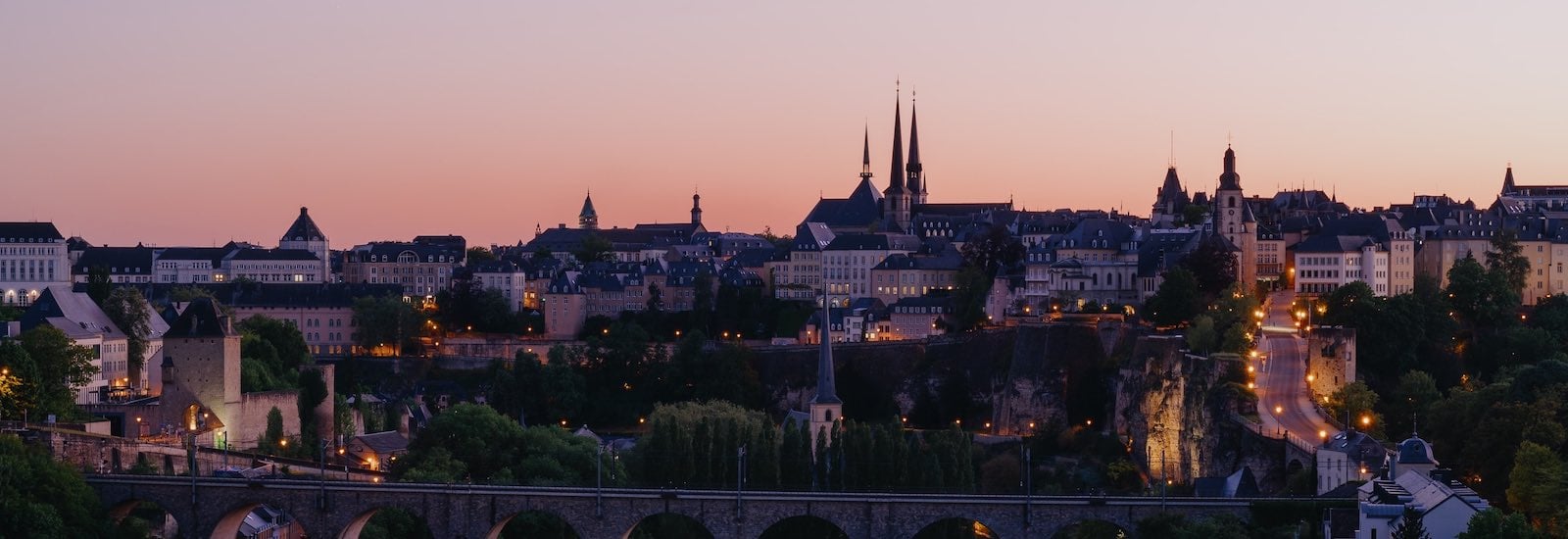

Want a safe place for your money that sits outside your home country but inside the EU? Opening a bank account in Luxembourg can give you that. Luxembourg is one of the smallest EU countries, yet its banking sector is large: the CSSF counted 118 licensed banks at the end of August 2026. Eligible deposits are protected up to €100,000 per bank. And you gain a stable, well-supervised home for part of your savings. This guide shows you how to open a bank account, what documents you need, what it costs, and how tax reporting works.
Why Bank in Luxembourg? Four Clear Benefits
The benefits of banking in Luxembourg go beyond a new IBAN. Banking in Luxembourg provides four things most people want when they move money abroad:
- Asset protection. The Fonds de garantie des dépôts Luxembourg (FGDL) covers eligible deposits up to €100,000 per person, per bank. Your currency and where you live don't change that.
- Diversification. Holding part of your savings in a second jurisdiction spreads your risk if something goes wrong at home.
- Access to many currencies. One bank's price list alone shows current accounts in 19 currencies, from US dollars to Swiss francs.
- Stability and strong oversight. The CSSF supervises banks here. In 2023, the Financial Action Task Force (FATF) found a solid framework for fighting money laundering and placed the country under regular follow-up, its best possible result. Luxembourg is not on the FATF grey list (June 2026) or the EU list of non-cooperative tax jurisdictions (February 2026).
What happens if a bank fails?
The FGDL aims to repay covered deposits within 7 working days. Some temporary high balances, such as money from selling your home, are covered up to €2.5 million if they arrived in the 12 months before a failure. Claims tied to investments fall under a separate scheme, the SIIL, which covers up to €20,000 per person, per institution. Deposits held at a bank's branches outside the EU are not covered by the FGDL.
Fact: 118 Banks Are Licensed Here, So Choose With Care
As of 31 August 2026, the CSSF counted 118 banks, including 48 branches. Older articles often quote higher numbers, so check the date on anything you read.
Many banks in Luxembourg serve private clients, companies and funds. Banks in the Grand Duchy often specialize in one area, such as private banking. Others focus on retail banking and transactional banking, like salary payments and bills. Well-known names include Spuerkeess (the state savings bank, also called BCEE), BGL BNP Paribas, Banque Internationale à Luxembourg (BIL), Raiffeisen and Banque de Luxembourg.
The CSSF supervises the country's banking systems day to day. The European Central Bank can also step in. On 1 August 2024, it withdrew the licence of Banque Havilland.
How do you find the best banks for you?
There is no single list of the best banks in Luxembourg. The right bank depends on you. Compare these points:
- Minimum deposit and monthly fees
- Currencies on offer
- Whether you can apply from abroad
- Languages spoken and the quality of the app and digital banking tools
- Whether you need international banking across several countries or wealth management solutions
Which Account Fits You Best?
Start with your banking needs. The account type you choose shapes the documents, the deposit and the fees.
Current accounts and savings accounts
A current account handles your day-to-day banking: card payments, transfers and bills. It usually comes with a Visa debit card and online banking. At Spuerkeess, for example, you manage everything in S-Net and the S-Net Mobile app. You can also add a credit bank card, such as Visa Classic or Visa Premier.
A savings account holds money you don't need every day. For larger sums, term deposits at Spuerkeess start at €10,000.
Multi-currency accounts
Want to hold dollars, francs and euros side by side? A multi-currency account lets you do that. Spuerkeess offers extra current accounts in AUD, CAD, CHF, CZK, DKK, EUR, GBP, HKD, HUF, JPY, NOK, NZD, PLN, RUB, SEK, SGD, TRY, USD and ZAR. Each extra account costs €5 a quarter, but Zebra Premium customers pay no maintenance fee on non-euro accounts.
Accounts for larger portfolios
Private banking and wealth management are built for high net worth individuals. Entry levels are high. Societe Generale, for example, asks private clients in Luxembourg for a minimum investment of €1,000,000. Other private banks set their own levels, and we confirm them for your case.
In return, you usually get a dedicated adviser and a wide range of services, including wealth management services. These can include investment accounts, investment products such as funds and bonds, and international investment across global markets. Some clients pair private banking services with an international trust for estate planning.
Business and corporate accounts
Companies can bank here too. At Spuerkeess, business pricing starts from €5 a month (excl. VAT) for a Zebra Business package and from €10 a month for a classic current account. The bank may add a servicing fee for complex files. Expect more checks than for a personal account. The bank wants to know who owns the company and what it does.
Do you need a local company? No. You can bank as a private person. Whether a bank will accept offshore companies formed outside the EU is each bank's own decision, made case by case. We confirm which banks fit your structure before you apply.
If you'd like a local structure, you can set up a company in Luxembourg. The SARL is the most common choice. It needs at least €12,000 in share capital and can have up to 100 shareholders. For SARLs formed from 2 June 2026, that minimum capital can be paid up to 12 months after formation, so you no longer need a bank account before you incorporate. An SA needs €30,000, with at least a quarter paid up at formation, according to Guichet.lu.
Can Foreigners Bank Here? Yes, With a Few Conditions
Banks here serve residents and non-residents alike, and your nationality alone won't stop you. Spuerkeess, for example, accepts non-resident applications, with some limits. As a non-resident, expect closer checks on where your money comes from.
Can you apply from abroad?
Sometimes. It depends on the bank and your nationality. Take Spuerkeess as an example:
- EU nationals (except those from Portugal, Greece, Ireland and Denmark) can open an account remotely in the S-Net Mobile app with a short video check.
- Everyone else uses the online form. For people moving to Luxembourg, the account stays semi-operational until you sign the final papers at a branch.
- Digital onboarding is closed to current or former customers and anyone who meets certain compliance criteria.
Other banks set their own rules, and many still want to meet you in person. We confirm the route for your case before you apply.
Your EU right to a basic account
Live legally anywhere in the EU? Then you have a right to a basic payment account under the Law of 13 June 2017. According to the CSSF, Spuerkeess, Banque Raiffeisen, BGL BNP Paribas and POST Luxembourg must offer one, and BIL has chosen to as well.
What Documents Do You Need?
Each bank sets its own specific requirements, but most ask for the same core papers.
For personal accounts
- Proof of identity: a valid passport or national ID card. Banks ask you to provide proof of identification for every account holder.
- Proof of address: a recent utility bill or rental contract, usually dated within three months.
- Proof of income: recent payslips or tax returns.
- Recent statements: bank statements from your current bank.
- Source of funds: a short explanation, with papers, of where your deposit comes from.
- Tax forms: a CRS self-certification, plus a W-9 (US persons) or W-8BEN (others) for FATCA.
- Reference letter: some banks also ask for a letter from your current bank.
For corporate accounts
- Certificate of incorporation, articles of association and any business licences
- A board resolution approving the account and naming who can sign
- An up-to-date register of directors and shareholders
- Proof of the registered office address
- A business plan or recent financial statements, where the bank asks for them
- Passports and proof of address for directors, shareholders and beneficial owners
Tip: Send clear, recent copies. Get them certified where the bank asks, and add certified translations for documents that aren't in English.
How to Open an Offshore Bank Account in Luxembourg
Ready to open an account in Luxembourg? Here's the account opening process, step by step.
- Set your goal. Decide what the account is for: savings, investing, business payments or a mix. Your goal decides the account and the bank.
- Choose a suitable bank in Luxembourg. Compare deposits, fees, currencies and remote options. A good banking partner fits your size and your plans.
- Gather your documents. Use the checklists above. Gaps in your file slow everything down.
- Apply. Apply online or contact the bank to book a meeting. Some banks assign a bank representative to guide you through opening the account.
- Pass the checks. The bank runs Know Your Customer and anti-money laundering checks. It may ask more about your funds or plans. Account approval is always the bank's decision.
- Get your access. Once approved, you receive your account details, cards and online login.
- Fund and manage. Make your first deposit and set up the app for account management, so you can check your account balances from anywhere.
Opening for your family? At Spuerkeess, parents can also open accounts for children under 18.
How long does it take?
Timelines vary by bank and by how complex your file is. For a basic payment account, the bank must accept or refuse within 10 business days of receiving a complete application. Private banking and company files usually take longer, because the bank reviews more documents. We give you a realistic timeline for your case once we see your file.
Why Work With Offshore Protection25 Years of Offshore Expertise. One Trusted Partner.Since 1996, we have helped thousands of entrepreneurs, investors, and high net worth individuals using the world's strongest offshore structures including trusts, foundations, international companies, and banking solutions tailored to your specific situation.✔ Boutique service ✔ Deep jurisdiction expertise ✔ Strict confidentiality
Fact: Everyday Accounts Can Cost Less Than €4 a Month
Banking fees on Luxembourg bank accounts vary by bank and package. Here is what Spuerkeess, the state savings bank, charges under its fee list dated 1 January 2026:
- Opening: no opening fee listed.
- Fees for account maintenance: €3.50 a month (Zebra) or €9.50 a month (Zebra Premium). Zebra Premium is free for the first six months if your application is accepted.
- Extra currency accounts: €5 a quarter, or free with Zebra Premium.
- Euro (SEPA) transfers to other banks: €0.75 each, or free inside a package.
- Transfers outside SEPA or in other currencies: 0.175%, minimum €10, maximum €100.
- Incoming payments in other currencies: 0.175%, minimum €7, maximum €40.
- Exchange fee on payments: 0.100%, minimum €2, maximum €100.
- Inactive relationship: €100 a year per account, excluding VAT.
Watch for minimum balance requirements too. Spuerkeess lists none for its current accounts, but private banks set high entry levels. Deposit thresholds vary by bank, and we confirm them for your case.
Banking features at a glance
| Feature | What to expect |
|---|---|
| Deposit | No legal minimum. Term deposits from €10,000 at Spuerkeess. Private banking from €1 million at Societe Generale; other banks vary. |
| Documents | ID, proof of address, income proof, source of funds, CRS and FATCA tax forms |
| Timeline | Varies by bank. Basic payment accounts: a decision within 10 business days of a complete file (CSSF) |
| Currencies | EUR plus 18 other currencies at Spuerkeess |
| Remote opening | In-app with a video check for most EU nationals at Spuerkeess; others apply online, and some finish at a branch |
| Fees | €3.50–€9.50 a month; transfers outside SEPA 0.175% (min. €10, max. €100) at Spuerkeess |
| Deposit protection | Up to €100,000 per person, per bank (FGDL) |
Fact: Your Account Is Reported to Tax Offices Every Year
Banks here share account data with foreign tax authorities. Plan for it from day one.
- CRS: Luxembourg takes part in the Common Reporting Standard. The CRS Law of 18 December 2015 took effect on 1 January 2016, and Luxembourg was among the countries that made their first exchanges in 2017. Banks must check the tax residence of every foreign account holder, not only those from partner countries.
- FATCA: The country signed a Model 1 agreement with the US on 28 March 2014 and made it law on 24 July 2015. Data on US persons goes to the US Internal Revenue Service.
- Interest tax: The 20% RELIBI withholding applies to certain interest paid to individuals who live in the country. If you live abroad, your home country's rules decide how the interest is taxed.
Numbered or anonymous accounts don't change any of this. The bank still knows and verifies who you are, and it reports your account under CRS and FATCA where they apply. These rules make cross-border banking more transparent. They also make an honest, well-documented file more important than ever.
How Is Luxembourg Offshore Banking Changing in 2026?
The biggest change this year is DAC8. Parliament adopted the law on 19 March 2026, and the Law of 27 March 2026 applies from 1 January 2026. It brings crypto-asset firms into automatic tax reporting. It also updates the CRS rules, so banks report extra data fields from 2026, such as whether an account is joint and whether a valid self-certification is on file. First reports under the new rules are due by 30 June 2027 (Harneys, May 2026). Grant Thornton notes that banks must update their CRS processes to cover the new obligations.
Company founders got good news too. Since 2 June 2026, a new SARL can pay its €12,000 minimum capital up to 12 months after formation (PwC, 2026). Lawmakers made the change because opening a bank account before incorporation often caused delays.
The banking sector remains strong. Profit before provisions and taxes reached €5,330.2 million in the first half of 2026, up 5.4% on a year earlier (CSSF, September 2026).
What our account files have taught us since 1996
Since 1996, we've helped clients prepare their bank files, and one pattern stands out. The files that move fastest tell the money story up front. Where did the funds come from? What will the account do? Which countries will payments go to? Answer those three questions before the bank asks, and you cut most of the back-and-forth.
What to expect next
Our view is that, as the new CRS fields take hold, banks will likely ask many existing clients to update their tax forms during 2026 and 2027. That's a forecast, not a certainty. Keeping your ID and tax residence details current is the simplest way to stay ready.
Is This Account Right for You?
An offshore account here gives you EU deposit protection up to €100,000, access to many currencies, and a stable, well-supervised home for part of your wealth. Opening one takes planning, clear documents and full tax transparency. You don't have to do it alone. Contact us today, and we'll help you choose a suitable bank and prepare a file that's ready from day one.
Have Questions? Start Here
- Can a foreigner open a bank account in Luxembourg?
Yes. Banks here accept clients of any nationality, whether or not they live in the country. Expect extra checks on your identity, address and source of funds. Some banks let most EU nationals open fully in an app, while others ask for a branch visit. Approval is always the bank's decision.
- How much does it cost to open and maintain a Luxembourg offshore bank account?
At Spuerkeess, no opening fee is listed, and everyday packages cost €3.50 or €9.50 a month (fees as of 1 January 2026). Zebra Premium is free for the first six months if your application is accepted. Transfers outside SEPA cost 0.175%, with a minimum of €10 and a maximum of €100. Private banks often charge more and ask for high deposits. Our own service fee for arranging a Luxembourg account is US$1,500.
- Is my money protected if a bank fails?
Yes, up to a limit. The FGDL covers eligible deposits up to €100,000 per person, per bank, in any currency and wherever you live. It aims to repay within 7 working days. Deposits at a bank's branches outside the EU are not covered.
- Can I open the account online?
Sometimes. Spuerkeess offers in-app opening with a video check for EU nationals, except those from Portugal, Greece, Ireland and Denmark. Other applicants use an online form, and some must finish at a branch. Rules differ from bank to bank.
- Is there a minimum deposit?
There is no legal minimum. Spuerkeess lists none for its current accounts, and its term deposits start at €10,000. Private banks start much higher: Societe Generale asks private clients in Luxembourg for at least €1 million.
- What documents do I need to open an account?
Most banks ask for a passport or ID card, recent proof of address, proof of income, proof of where your funds come from, and CRS and FATCA tax forms. Companies also need their formation papers, a board resolution and details of their owners and directors.
- How long does it take to open a Luxembourg bank account?
It varies by bank and by how complex your file is. For a basic payment account, the bank must decide within 10 business days of receiving a complete application. Private banking and company files usually take longer.
- Will my account be reported to my home tax office?
Yes, in most cases. Under CRS, banks here report account data to the tax office of the country where you live. Data on US persons is also shared under FATCA.
- Are Luxembourg bank accounts secret or anonymous?
No. Banks must identify and verify every account holder and beneficial owner. Even a numbered account is known to the bank, and it is reported under CRS and FATCA where they apply. Luxembourg banking offers stability and strong supervision, not secrecy.
- Is Luxembourg on the FATF grey list or the EU tax blacklist?
No. Luxembourg is not on the FATF grey list (June 2026 update) or the EU list of non-cooperative tax jurisdictions (February 2026 update). After its 2023 evaluation, the FATF placed it under regular follow-up.
- Can I get a free account?
Some packages are free for a while. Spuerkeess waives its Zebra Premium fee for the first six months if your application is accepted, and its Axxess Study account is free until your 30th birthday.
- Do I need a local company to bank here?
No. You can open a personal account. If you do want a local SARL, it needs at least €12,000 in share capital, which since 2 June 2026 can be paid up to 12 months after formation. Each bank decides case by case whether to accept foreign companies.
How Offshore Protection Can Help
____
Offshore Protection is a boutique consultancy specializing in offshore solutions creating bespoke global strategies using offshore companies, trusts, and second citizenships so you can internatioanlize and diversify your business and assets.
We help you every step of the way, from start to finish with a global team of dedicated consultants. Contact us to see how we can help you.









