

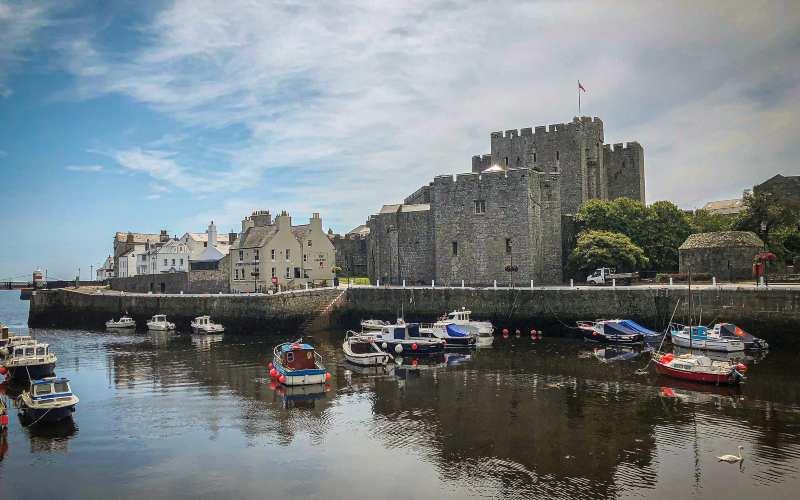
What if you could own a 0% tax company in a jurisdiction nobody calls a tax haven? That's the Isle of Man. It's a self-governing British Crown dependency located in the Irish Sea between Great Britain and Ireland — never part of the United Kingdom, but firmly inside the British Isles and the UK customs and VAT area. You get a zero corporate rate, an English-speaking common-law system, and a reputation built over decades of serious finance. Company formation in the Isle of Man takes days, not weeks, and you never have to visit. Here's everything an Isle of Man formation involves.
Why Form a Company in the Isle of Man?
Most zero-tax jurisdictions make you choose between low tax and credibility. The Isle of Man refuses that trade.
It's an established international business and finance centre built on political stability and low taxation — and it sits on the OECD 'white list', having met the standards set by the IMF, the FATF and the EU. That combination gives you a business environment most offshore companies simply can't offer their owners. The advantages:
- 0% corporate income tax for most companies (10% applies to certain banking and property income, 20% to a narrow band — details below).
- A serious reputation. This is not a brass-plate island. The Isle of Man Government has its own parliament, Tynwald, and a mature regulatory framework overseen by the Isle of Man Financial Services Authority.
- Not part of the United Kingdom — but inside the UK VAT area, with a customs agreement that facilitates trade. Isle of Man companies can also move goods to EU and EEA countries without paying import tariffs.
- No travel required. You never need to set foot on the island to incorporate.
- Fast incorporation — as little as two business days under the 2006 Act, or under two hours for an additional government fee.
- One shareholder, one director is enough under the 2006 Act, and both can be corporate bodies of any nationality, resident anywhere.
- Real privacy. Beneficial ownership is not open to the public, and financial accounts aren't published either.
- Separate legal entity status with indefinite existence, limited liability for shareholders, no exchange controls, and English as the official language.
For more, see the advantages of the Isle of Man as an offshore financial centre.
What Our Clients SayTrusted by Thousands of Clients Since 1996."Offshore Protection helped me structure my assets in a way I never thought possible. Professional, discreet, and thorough — I wouldn't trust anyone else with my offshore strategy."— Private Investor, United States★★★★★
4.8 stars · 230 verified reviews
1931 Act or 2006 Act: Which Isle of Man Company Do You Want?
This is the question almost every Isle of Man formation page skips — and it changes everything about your company.
The island runs two parallel company law regimes at once (Appleby, Guide to Companies in the Isle of Man, April 2025):
- The 1931 Act (Companies Acts 1931–2004) — closely modelled on the English Companies Act 1929 and traditional English company law. Requires two directors, who must be individuals, and a qualified company secretary. Favoured by local Manx businesses. Shareholder details are published in the annual return.
- The 2006 Act (Companies Act 2006) — follows the international business company model used across leading offshore jurisdictions. Requires only one director, permits corporate directors, needs no company secretary, and doesn't publish shareholder details. Instead, it must have a licensed registered agent at all times.
Which should you pick? For foreign-owned international structures, the newer vehicle is almost always the answer — it's faster, leaner, and more private. The older regime suits owners who want traditional English-law governance or a locally trading business. A 1931 Act company may freely convert to the newer form; the reverse is not permitted, so choose deliberately.
Both regimes carry identical tax treatment and identical economic substance obligations. The rest of this page covers both, flagging the differences as they arise.
Types of Companies Available in the Isle of Man
Beyond the two acts, setting up a company here gives you real structural choice:
- Company limited by shares (Ltd). The most-used vehicle by far, under either act. The name must end in "Limited" or "Ltd".
- Company limited by guarantee, or a hybrid (guarantee plus share capital).
- Unlimited company — with or without shares.
- Limited Liability Company (LLC). A US-style limited liability company is available under the Limited Liability Companies Act 1996
- Offshore trust. Often paired with a company for asset holding and estate planning — see our Isle of Man trust page.
Top Uses for Isle of Man Companies
One structure, many jobs:
- International trading, especially import and export of goods into and out of the EU
- E-commerce and online business
- International holding companies — physical and intellectual property
- Investment holding and commercial property structures (helped by UK VAT area membership)
- Registration and holding of sea vessels and yachts

Key Corporate Features
| Isle of Man Limited Company | Corporate Details |
|---|---|
| General | |
| Type of entity | Private company limited by shares (1931 Act or 2006 Act) |
| Type of law | English common law |
| Governed by | Companies Acts 1931–2004, or Companies Act 2006 |
| Registered office in Isle of Man | Yes |
| Licensed registered agent | Required for 2006 Act companies at all times |
| Shelf / ready-made company availability | Yes |
| Our time to establish a new company | 2–5 business days (under 2 hours possible for an extra government fee) |
| Minimum government fees (excluding taxation) | GBP 195 |
| Corporate taxation | 0% standard (10% / 20% for specified sectors) |
| Access to double taxation treaties | Limited treaty with the UK only |
| Share capital | |
| Standard / permitted currency | GBP / any |
| Minimum paid up | GBP 1 (a single share, which need not carry a par value under the 2006 Act) |
| Usual authorized | GBP 2,000 |
| Bearer shares allowed | No |
| Directors | |
| Minimum number | One (2006 Act) / Two (1931 Act) |
| Local director required | No (subject to economic substance rules) |
| Corporate directorship allowed | Yes (2006 Act) / No (1931 Act) |
| Publicly accessible records | Yes |
| Location of meetings | Anywhere |
| Shareholders | |
| Minimum number | One (individual or corporate, any nationality, resident anywhere) |
| Maximum number | 50 for a private company |
| Publicly accessible records | Yes (1931 Act) / No (2006 Act) |
| Company secretary | |
| Required | Yes, qualified (1931 Act) / No — licensed registered agent instead (2006 Act) |
| Accounts | |
| Requirement to prepare accounts | Yes — kept at the registered office |
| Audit requirements | Yes (small companies exempt) |
| Requirement to file accounts | No |
| Publicly accessible accounts | No |
| Recurring government costs | |
| Minimum annual tax / annual return filing fee | GBP 360 / GBP 360 |
| Migration of domicile permitted | Yes |
How Much Does Isle of Man Company Formation Cost?
The island is a premium jurisdiction, and the price reflects what you're buying: reputation, not just a certificate.
Our complete Isle of Man company formation service is US$4,800. That covers government registration fees, your registered office address and licensed registered agent for the first year, the certificate of incorporation, memorandum and articles, first director appointments, share certificates, and your statutory registers. Annual renewal — registered agent and registered office — runs from US$2,100. Accounting, tax returns, the annual return and compliance review are billed separately, and we can refer you to an accountant who handles them.
Two add-ons worth knowing about: a resident director (needed for some activities, and relevant to economic substance) and an Isle of Man bank account, which local banks generally reserve for island residents.
What Do You Need to Incorporate?
Less than you'd expect — but the due diligence is thorough.
The documents filed with the Companies Registry:
- Form 1 — the company name, its local address, and the names of directors and secretary. Signed by the subscribers to the memorandum and by each director and secretary (1931 Act).
- The Memorandum of Association — referencing your share capital, shareholder details, registered office, registered agent, and limited liability.
- The Articles of Association — governing internal management. Use the model articles provided under Isle of Man company law, or have them drafted to fit your structure.
Your due diligence pack (to satisfy money laundering regulations): a certified copy of your passport, a certified utility bill or bank statement dated within the last three months, and a selfie. Documents not in English need a sworn translation bearing the translator's seal, then certification by an accountant, lawyer or notary.
Your company name can be in English or another Latin-alphabet language, subject to a certified English translation. It must not imply a regulated activity, contain a sensitive word — bank, insurance, trust, finance, council, Chamber of Commerce and similar all need prior approval — or be offensive. It must end with "Limited" or "Ltd".
The Company Registration Process
The company registration process is simple and efficient once your paperwork is clean. Your Isle of Man company registration runs in five steps:
- Secure your company name with the Companies Registry.
- Prepare the Memorandum of Association and articles, and confirm your ownership structure — how many shares to each shareholder, at what price, in which currency.
- File the incorporation documents. Only a licensed Isle of Man registered agent can incorporate a 2006 Act company, which is why a corporate service provider is not optional here — it's the law.
- Prepare KYC and AML documents for your corporate bank account.
- Receive your certificate of incorporation. Approval typically lands within two business days of submission for a 2006 Act company; allow around five working days overall, subject to compliance review.
A note on timing: in-depth compliance checks are standard and are the usual cause of delay. Under the 2006 Act, your first director doesn't even have to be named at formation — you have one month after incorporation to appoint them. See our guide on how to set up a company in the Isle of Man for the full walkthrough.
Why Work With Offshore Protection25 Years of Offshore Expertise. One Trusted Partner.Since 1996, we have helped thousands of entrepreneurs, investors, and high net worth individuals using the world's strongest offshore structures including trusts, foundations, international companies, and banking solutions tailored to your specific situation.✔ Boutique service ✔ Deep jurisdiction expertise ✔ Strict confidentiality
Opening a Corporate Bank Account
Here's a useful piece of freedom: your company and your bank don't have to live in the same place.
You can open an offshore business bank account for an Isle of Man company in most countries around the world, and it's actually more common to bank somewhere other than the country of incorporation. We have banking connections in dozens of jurisdictions. Which one we recommend depends entirely on your situation — some banks want in-person visits, higher deposits, deeper due diligence and references, while others have minimal requirements.
Local Isle of Man bank accounts are a different matter: they're generally available only to island residents. Get in touch for a consultation before you choose.
How Are Isle of Man Companies Taxed?
The headline is simple: most Isle of Man companies pay nothing. The island sets its own tax regime, independently of the UK.
- Corporate income tax: 0% for most companies. A 10% rate applies to banking business and certain retail and property income, with a 20% rate on a narrow band including Manx land and property income
- No withholding tax, no dividends tax, no capital gains tax, no stamp duties.
- Capital duty on issued shares: GBP 130 where share capital is under GBP 2,000, then GBP 17 per GBP 1,000 of authorized capital above that, capped at GBP 5,000
- VAT: the Isle of Man forms part of the UK VAT area. Registration is required once turnover is expected to exceed GBP 82,000 in a year, and voluntary registration is available
- Treaties: a limited treaty with the UK only — the Isle of Man is not part of a broad double tax treaty network. If treaty access matters to your structure, this is the trade-off you're accepting for the 0% rate.
Economic substance is the catch nobody advertises. Isle of Man tax resident companies earning income in certain sectors must show real substance on the island — that they're directed and managed there and carry out their core income-generating activities there (Appleby, April 2025). Pure mailbox structures no longer work. Before you incorporate, get independent written tax advice; reputable agents will ask to see it before they proceed.
How Is Isle of Man Company Formation Changing in 2026?
The Isle of Man is tightening its registry — and doing it in public. Three things happened in the last eighteen months that anyone forming a company here should know.
First, the Central Registry ran a seven-week consultation on aligning the island's corporate laws with FATF standards, closing 16 January 2026 with 16 responses. The resulting Verification of Entity Registration Bill was set for introduction to the Legislative Branches in April 2026, alongside a Tynwald Order in May amending the definition of "registrable beneficial owner" to match the FATF standard (Isle of Man Government, consult.gov.im). Second, the Registry set a hard deadline of 27 February 2026 for every Isle of Man company to bring its beneficial ownership details up to date — Registrar General Edward Clague warned that continued default risks civil penalties or being struck off the Register (Department for Enterprise, 18 February 2026). Third, director notification requirements tightened from 1 April 2025, with transitional provisions for boards that were never properly notified (Conventus Law, March 2025).
After 25 years of forming companies, here's what that pattern actually tells you: the Isle of Man is not raising its tax rate, it's raising its filing standard. That's a deliberate strategy. Jurisdictions competing on secrecy have spent a decade losing banking relationships; the island is buying long-term access by making itself boring to regulators. In practice this means the cheap end of the market gets squeezed while structures with real substance and clean filings get easier — the opposite of what most people assume "offshore" is heading toward.
Our hedged prediction: with the Bill in train and the Registry openly planning a public company-data API in its Business Plan, expect more information to become verifiable — though beneficial ownership itself looks set to stay restricted to competent authorities rather than going public, as several UK Overseas Territories have resisted. Timing on legislation always slips, so treat April and May 2026 as direction, not gospel.
Corporate Details Worth Knowing
Privacy and Disclosure
Be precise about what's public here. Director details, Form 1, the memorandum and the articles are all on the public record. Beneficial ownership is not — it's held centrally and released only to competent authorities and obliged entities regulated under the island's AML/CFT Code. Financial accounts are not published either. Shareholder information is public for 1931 Act companies but not for 2006 Act companies. Nominee services are permitted; note that nominee shareholders and directors must be Isle of Man residents. If confidentiality is a priority, the newer regime is the clear choice.
Beneficial Ownership and the Nominated Officer
Every Manx company must appoint a "nominated officer" resident in the Isle of Man to hold beneficial owner details — unless the company receives corporate services from a licensed provider, which ours do. This is the mechanism behind the February 2026 enforcement drive above.
Company Shares
Shares may be ordinary, convertible, redeemable, preference or non-voting, with rights set out in the articles. Bearer shares are not allowed. Under the 2006 Act, shares can be issued with or without a par value and denominated in any currency.
Meetings, Powers and Local Requirements
A company has all the powers of a natural person. A local registered office is required, and your registers of members, directors and secretaries must be kept there; financial records may be held elsewhere in the world but must be sent to the registered office every six months. Meetings can be held anywhere — under the older regime they're required annually, and under the newer one they can be held wherever your director happens to be.
Accounts, Audit and Financial Statements
Companies must prepare accounts and keep them at the registered office, but there's no requirement to file audited financial statements with the Isle of Man Financial Services Authority. An audit is required unless the company is exempt — exemption applies where it meets two of three tests: turnover under GBP 5.6m, balance sheet under GBP 2.8m, or 50 or fewer employees. Companies whose members are all directors throughout the year and which exist to hold shares, securities, investments or land are also exempt. Each year the company prepares a balance sheet, directors' report, auditors' report and profit and loss account.
Trading Restrictions and Higher-Risk Activities
Banking, insurance, investment management and soliciting public funds all require the appropriate licence first. Gambling and cryptocurrency businesses are considered on a case-by-case basis and need a detailed business plan — the Isle of Man does accept crypto activity, but expect extra cost and scrutiny.

Offshore Protection Company Formation Package
Company Registration Package Includes:
- Government Registration Fee (First year)
- Registered Office Address (First year)
- Registered Agent Services (First year)
- Company Secretarial Maintenance
- Certificate of Incorporation
- Memo & Articles of Association
- Appointment of 1st Directors
- Consent Actions of the BOD
- Share Certificates
- Register of Directors
- Register of Officers
- Register of Shareholders
- FREE Phone and/or email consultations
Join thousands of satisfied clients who have experienced the Offshore Protection advantage for more than 25 years. When you purchase any of our offshore company formation products, you'll get FREE support from our lawyers to help answer your day-to-day management questions. Order an Isle of Man company with or without a bank account.
See more: Isle of Man New Manx Vehicle (NMV) Company
FAQ
- Can a foreigner start a business in the Isle of Man?
Yes. Any individual or company can register an Isle of Man entity through a licensed registered agent, and directors and shareholders can be of any nationality, resident anywhere in the world. Individual directors must be at least 18. You are not required to travel to the island at any point.
- How much does it cost to form and renew an Isle of Man company?
Our complete formation service is US$4,800, covering government fees, first-year registered office and registered agent, certificate of incorporation, memorandum and articles, and statutory registers. Annual renewal of the registered agent and registered office runs from US$2,100. Accounting, tax returns, the annual return and compliance review are billed separately.
- How long does Isle of Man company formation take?
A 2006 Act company is typically incorporated within two business days of submission, and for an additional government fee it can be ready in under two hours. Allow around five working days end to end, since in-depth compliance checks are standard and are the usual cause of delay.
- What is the difference between a 1931 Act and a 2006 Act company?
A 1931 Act company follows traditional English company law: two directors who must be individuals, and a qualified company secretary. A 2006 Act company follows the international business company model: one director, corporate directors permitted, no company secretary, and no published shareholder details — but it must have a licensed registered agent at all times. A 1931 Act company can convert to a 2006 Act company, but not the reverse.
- Do I need a company secretary for an Isle of Man company?
Only for a 1931 Act company, where a qualified secretary — a natural person of any nationality, resident anywhere — is required. A 2006 Act company needs no company secretary; instead it must maintain a licensed Isle of Man registered agent at all times, which is why a corporate service provider is mandatory rather than optional.
- Do Isle of Man companies really pay 0% tax?
Most do. The standard corporate income tax rate is 0%, with 10% applying to banking and certain retail and property income and 20% to a narrow band. There is no withholding tax, dividends tax, capital gains tax or stamp duty. But companies earning income in certain sectors must meet economic substance requirements — being genuinely directed and managed from the island — so get independent tax advice before you incorporate.
Ready to Start Your Isle of Man Formation?
A 0% tax rate, an Irish Sea Crown dependency with real credibility, formation in days without ever visiting, and privacy that still stands up in 2026 — the Isle of Man remains one of the strongest foundations for a successful business structure. Since 1996, Offshore Protection has built companies exactly like this for thousands of clients. Contact us for a free consultation and let's build yours.
How Offshore Protection Can Help
____
Offshore Protection is a boutique consultancy specializing in offshore solutions creating bespoke global strategies using offshore companies, trusts, and second citizenships so you can internatioanlize and diversify your business and assets.
We help you every step of the way, from start to finish with a global team of dedicated consultants. Contact us to see how we can help you.